Studio 8 Task Manager — Real-Time Workspace
A high-concurrency, real-time collaboration platform combining WhatsApp-style conversational workflows with structured Kanban task management.
Engineered with Go (Golang), Next.js 16 (React 19), PostgreSQL 17, Redis, RabbitMQ, and Docker/Nginx.
Quick Summary & Project Links
- Role: Full-Stack / Go Backend & DevOps Engineer
- Target Domains: Go Backend Engineering · DevOps / Infrastructure · Full-Stack Development
- Live Demo: https://s8.studio8.my.id
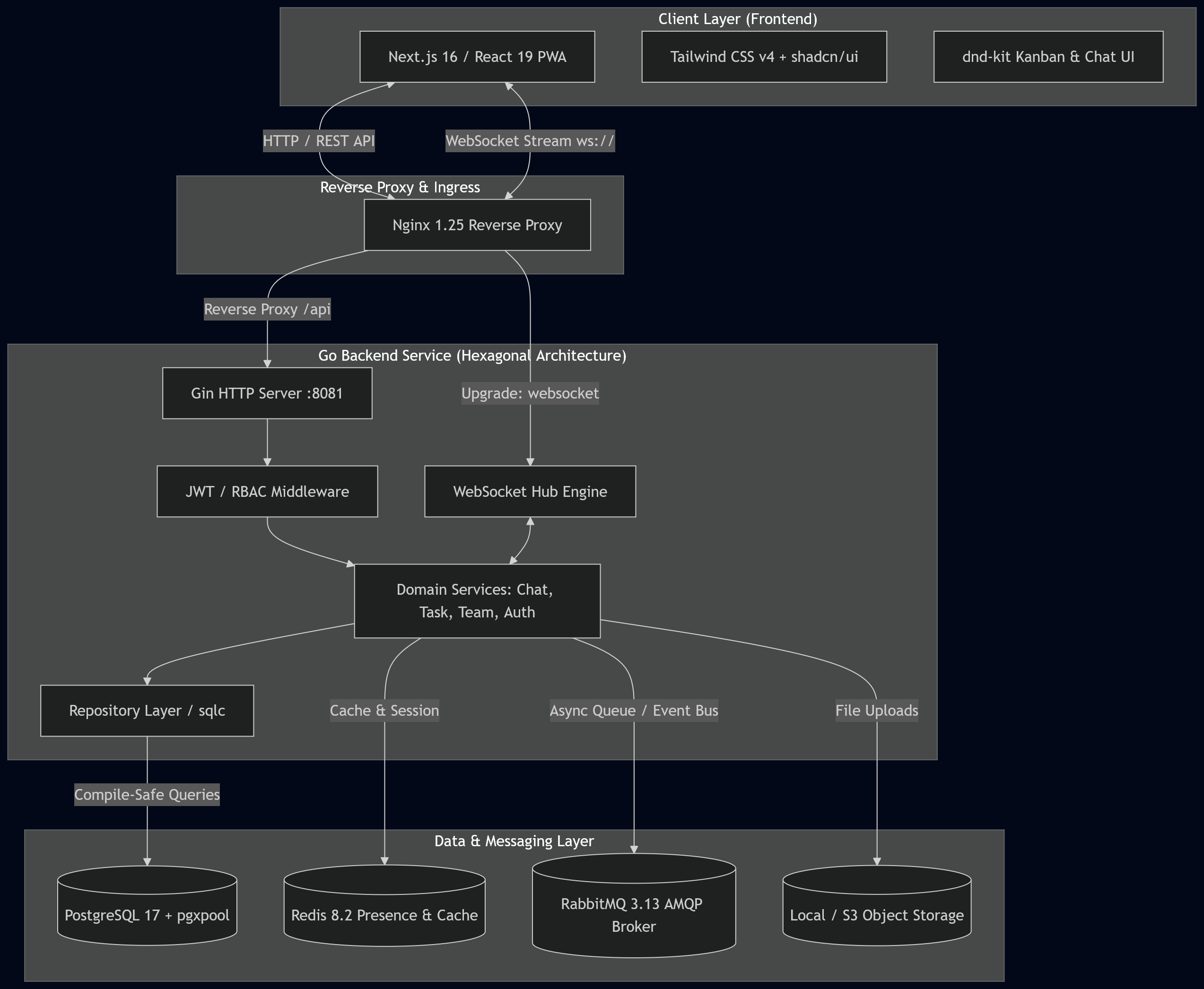
- Core Architecture: Hexagonal / Ports & Adapters Architecture + WebSocket Hub Pattern
Project Showcase
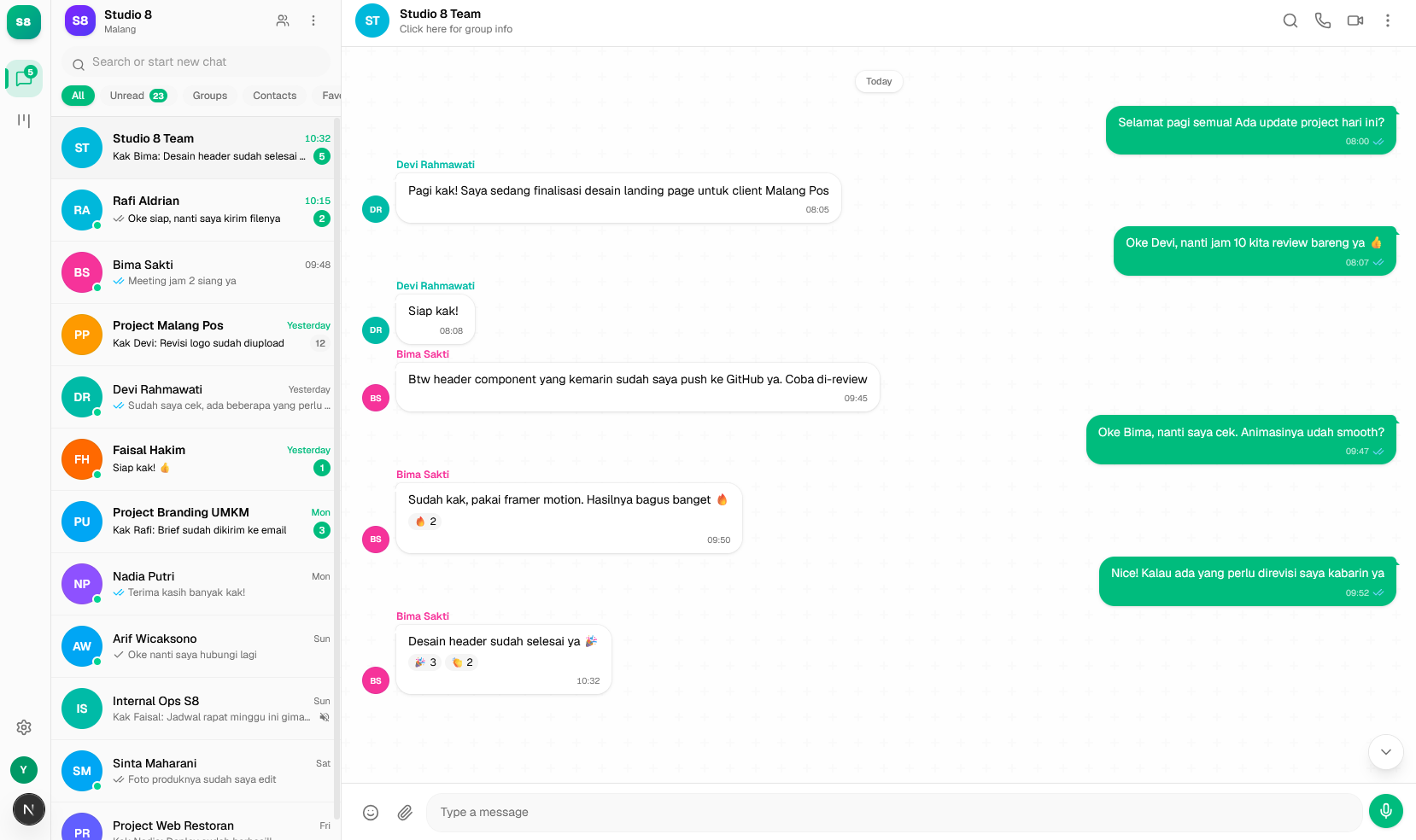
1. Unified Workspace & Chat-to-Task Interface
 Zoom
Figure 1: Main workspace showing real-time 1:1 / group chat with inline task creation, priority rating, and status tagging.
Zoom
Figure 1: Main workspace showing real-time 1:1 / group chat with inline task creation, priority rating, and status tagging.
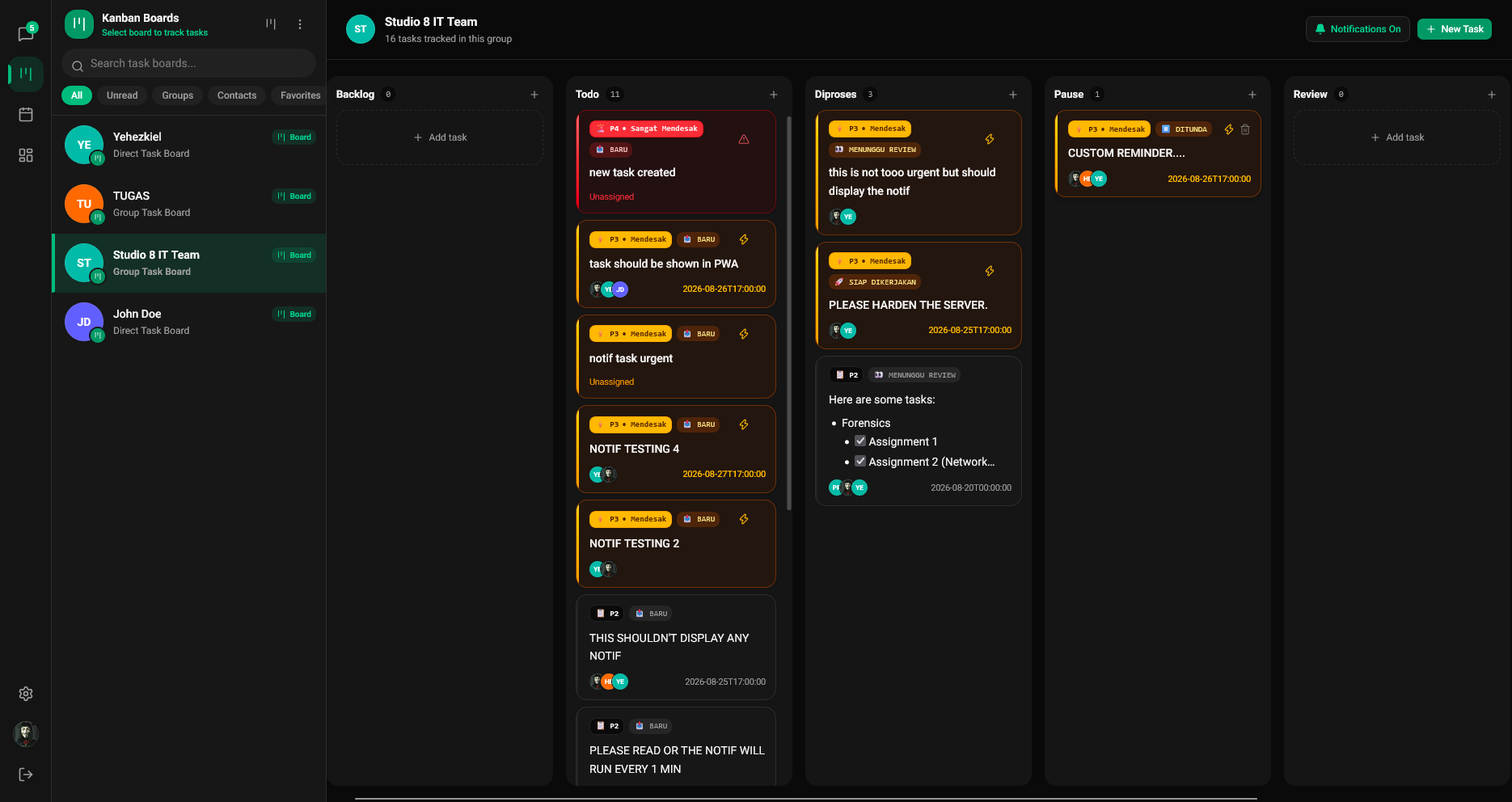
2. Interactive Kanban & Task Lifecycle Management
 Zoom
Figure 2: Kanban board with fluid drag-and-drop (@dnd-kit), multi-criteria filtering (status, priority 0-4, assignee), and task progress breakdown.
Zoom
Figure 2: Kanban board with fluid drag-and-drop (@dnd-kit), multi-criteria filtering (status, priority 0-4, assignee), and task progress breakdown.
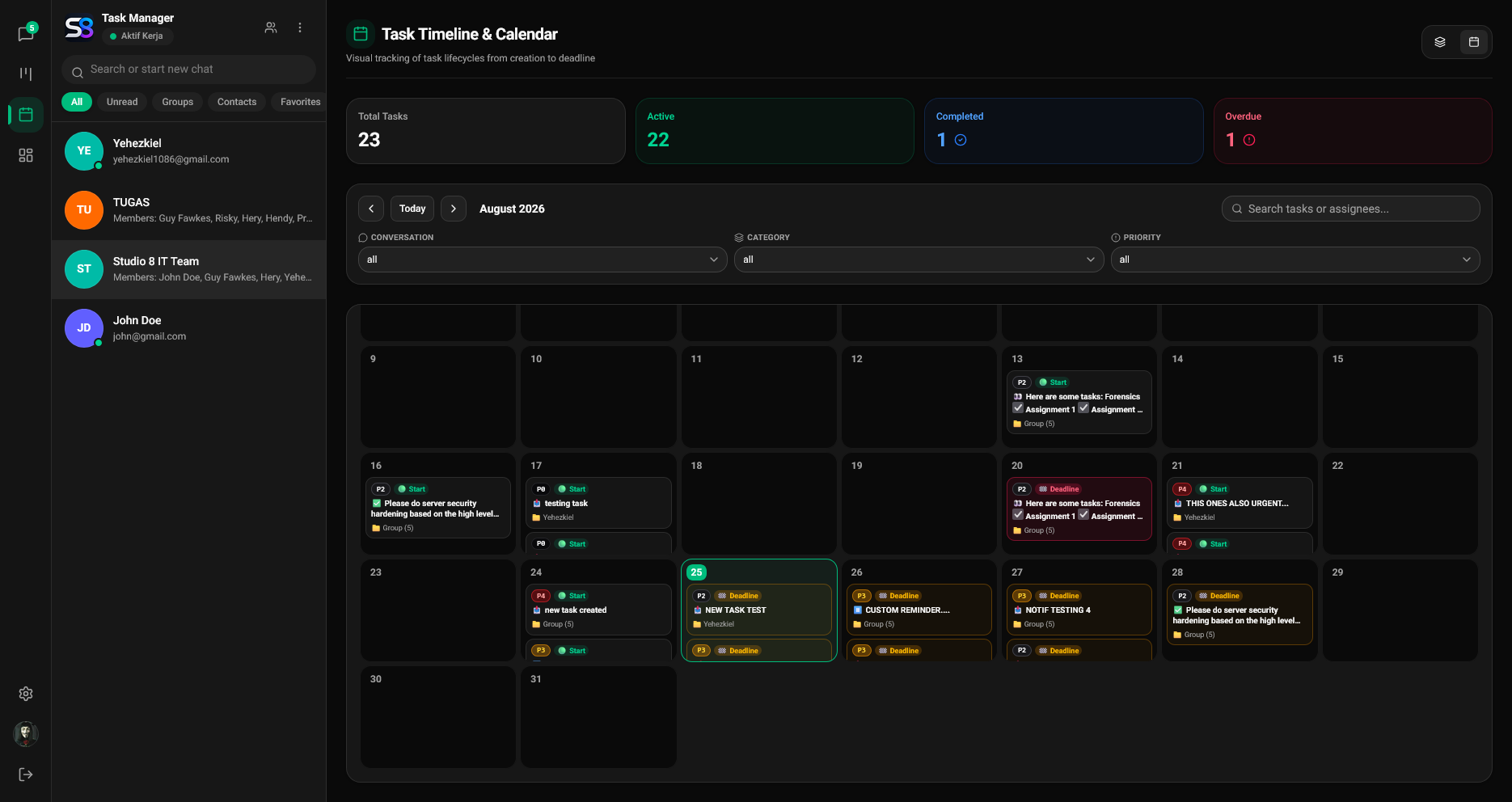
3. Calendar & Timeline Scheduling
 Zoom
Zoom
🏗️ System Architecture & Engineering Highlights
 Zoom
Zoom
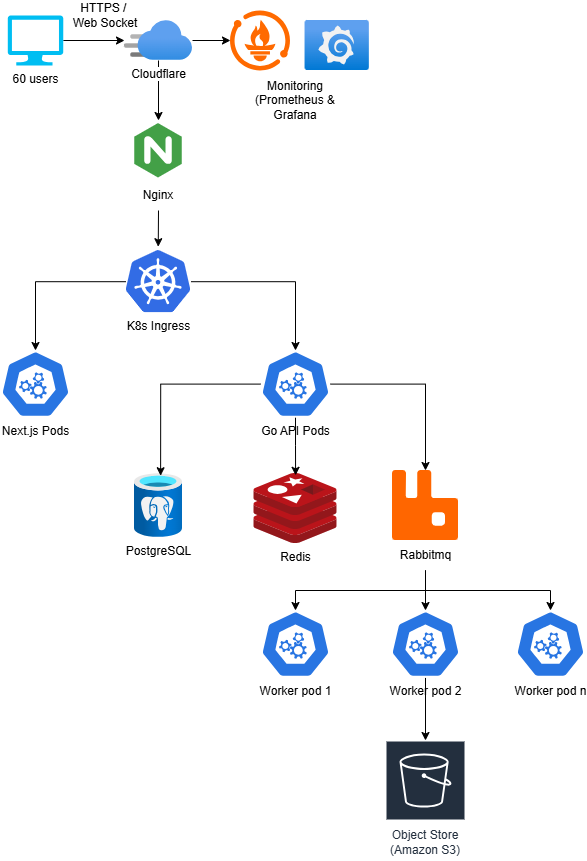 Zoom
Zoom
Key Technical Strengths & Domain Highlights
1. Go Backend Engineering
- Hexagonal Architecture (Ports & Adapters): Strict domain isolation separating core entities (
domain/), business interfaces (port/), orchestration services (service/), and external drivers (adapter/for HTTP, WebSocket, PostgreSQL, Redis, RabbitMQ). - High-Throughput WebSocket Hub: Built a concurrent publish/subscribe WebSocket hub leveraging Go channels (
chan *Client,chan *RoomSubscription,chan *BroadcastPayload) andsync.RWMutexto handle concurrent connections, room dispatching, and automated dead-client pruning. - Type-Safe High-Performance SQL (
sqlc+pgx/v5): Avoided slow reflection-heavy ORMs by generating compile-time Go code directly from raw PostgreSQL queries, backed bypgxpoolconnection pooling. - Robust Auth & RBAC Middleware: JWT authentication with access/refresh token rotation, bcrypt password hashing, Google OAuth2 integration, and role-based route guards.
- Structured Database Migrations: Programmatic Go-driven migration engine (
db/migration/) executing incremental schema migrations with transaction safety.
2. DevOps & Infrastructure
- Optimized Multi-Stage Docker Builds:
- Multi-stage build (
golang:1.25-alpine->alpine:latest). - Binary compilation optimized with
CGO_ENABLED=0and-ldflags="-w -s"to strip debug tables, resulting in ultra-compact container image sizes (~25MB). - Security hardening: non-root user execution (
appuser:appgroup).
- Multi-stage build (
- Microservices Orchestration via Docker Compose:
- Integrated orchestration for Go API, PostgreSQL 17, Redis 8.2 (with AOF persistence), and RabbitMQ 3.13.
- Automated health check conditions (
pg_isready,redis-cli ping) ensuring reliable dependency boot order. - Persistent named volumes for zero data loss on service restarts.
- Nginx Reverse Proxy & WebSocket Gateway:
- Configured reverse proxy to handle Next.js static asset caching (
/_next/), dynamic SSR, REST API proxying (/api), and HTTP/1.1 WebSocket upgrades (Upgrade: $http_upgrade,Connection: "upgrade"). - Configured secure static file routing for
/uploadswith real client IP forwarding.
- Configured reverse proxy to handle Next.js static asset caching (
- Automated Developer Workflow (
Taskfile.yml):- Integrated
Taskfilerecipes for one-command environment startup (task compose:up), schema codegen (task db:gen), and hot-reloading development viaair.
- Integrated
3. Full-Stack Development
- Next.js 16 + React 19: Modern App Router paradigm with React Server Components, server actions, client boundaries, and optimized font/asset loading.
- Interactive Drag-and-Drop Kanban: Engineered with
@dnd-kit/coreand@dnd-kit/sortable, allowing seamless dragging across 15 workflow states with immediate optimistic UI updates and real-time backend synchronization. - Hybrid Chat & Task Dual State: Real-time chat stream where messages can be promoted to actionable tasks with assigned priority (0–4), status transitions, attachments, and subtask breakdowns.
- PWA (Progressive Web App): Configured web app manifest, service worker lifecycle, responsive viewport design for desktop and mobile devices.
Deep Dive: Real-Time WebSocket Concurrency in Go
WebSocket Hub Architecture
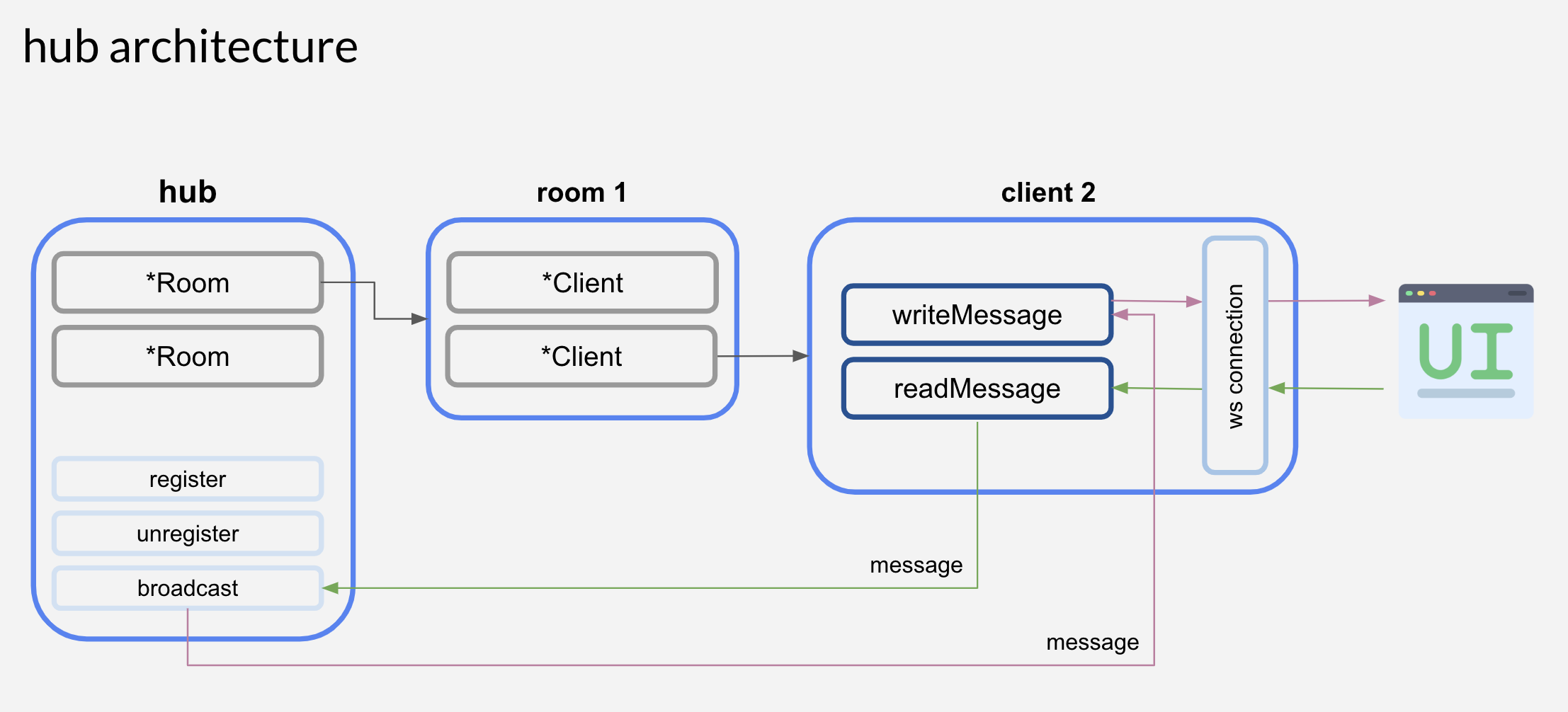
The core messaging engine coordinates rooms and clients concurrently using Go goroutines and channel multiplexing:
 Zoom
Zoom
Figure 3: WebSocket Hub concurrency model with Register, Unregister, JoinRoom, and Broadcast channels.
How Room Joining & Message Broadcasting Works:
- Client connects to
/api/ws/chat?token=<JWT> - Hub registers client in user connection pool (Clients[userID][*Client])
- Client joins room: RoomSubscription dispatched to JoinRoom channel
- Message sent -> Hub fan-out: broadcasts payload to all active room clients via buffered chan
- If write fails / client disconnects -> Hub drains dead client from memory to prevent leaks
🗄️ Database Design & Data Dictionary
Relational schema in PostgreSQL 17 modeling Users, Teams, Conversations, Messages, TaskMeta, Subtasks, and Read Receipts.
Key Entities & Data Dictionary
| Table | Description | Key Attributes / Indexes |
|---|---|---|
users | User credentials, profiles, Google OAuth | id (UUID), email (UNIQUE), role, password_hash |
teams & team_members | Organization hierarchy & workspace membership | team_id, user_id, role (admin/member) |
conversations | 1:1 DM & group team conversation channels | id (UUID), type (direct/group), group_id |
messages | Chat history, rich text payloads, timestamps | id, conversation_id, sender_id, type (chat/task) |
task_meta | 15-state status enums, 0–4 priority ratings | message_id, status (enum), priority (0-4), assignee_id |
subtasks | Granular sub-item checklists tied to parent task | id, task_id, title, is_completed |
attachments | File metadata, MIME types, upload URLs | id, message_id, file_url, file_type |
🛠️ Complete Tech Stack Matrix
| Domain | Technologies |
|---|---|
| Backend Language & Framework | Go 1.25 · Gin Web Framework · gorilla/websocket |
| Architecture Pattern | Hexagonal (Ports & Adapters) · Domain-Driven Design (DDD) |
| Database & Caching | PostgreSQL 17 (pgx/v5, sqlc) · Redis 8.2 Alpine |
| Message Broker | RabbitMQ 3.13 Alpine (AMQP Protocol) |
| Frontend Framework & Libs | Next.js 16 · React 19 · TypeScript 5 · @dnd-kit · Lucide Icons |
| Styling & Components | Tailwind CSS v4 · shadcn/ui · Base UI · tw-animate |
| DevOps & Infrastructure | Docker · Docker Compose · Nginx · Alpine Linux · Taskfile · Air |
| Security & Auth | JWT (Access/Refresh Token Rotation) · Google OAuth2 · Non-root Linux Containers |
💡 Engineering Challenges & Solutions
1. Concurrency & Connection Leaks in Real-Time WebSockets
- Problem: In a fast-paced chat and task environment, network dropouts or abrupt client closes can cause dead goroutines, memory leaks, and blocking broadcast channels.
- Solution: Implemented dedicated
readPumpandwritePumpper client with pong/ping heartbeats (SetReadDeadline,SetWriteDeadline). Buffered broadcast channels (make(chan *BroadcastPayload, 100)) prevent slow clients from blocking the hub's mainselectloop, automatically detecting and unregistering broken connections.
2. High Performance Database Querying without ORM Overhead
- Problem: Traditional reflection-based Go ORMs introduce runtime overhead and obscure complex SQL join logic.
- Solution: Adopted
sqlcto generate idiomatic, type-safe Go structs and queries directly from raw SQL schema and queries, pairing it withjackc/pgx/v5connection pooling for maximum database throughput.
3. Dual-Context UI (Chat-Driven Task Management)
- Problem: Users need both real-time WhatsApp-style fast conversation and structured task tracking without switching between disconnected applications.
- Solution: Built a unified data model where any chat message can atomically attach
TaskMeta(status, priority, assignee, subtasks). WebSocket events trigger real-time updates on both the chat stream and the Kanban board simultaneously.
4. Container Orchestration & Secure Ingress
- Problem: Running Next.js SSR, Go REST API, WebSocket streams, Redis, RabbitMQ, and PostgreSQL requires clean networking, health checks, and single-port SSL/HTTP routing.
- Solution: Configured an Nginx reverse proxy routing
/to Next.js (port 3003) and/api+/uploadsto Go (port 8081) with full WebSocket upgrade headers. Docker Compose healthchecks ensure database readiness before API startup.